

Creativity and Magical Thinking
Is our muse driven by magic and manifestation or psychology and science?

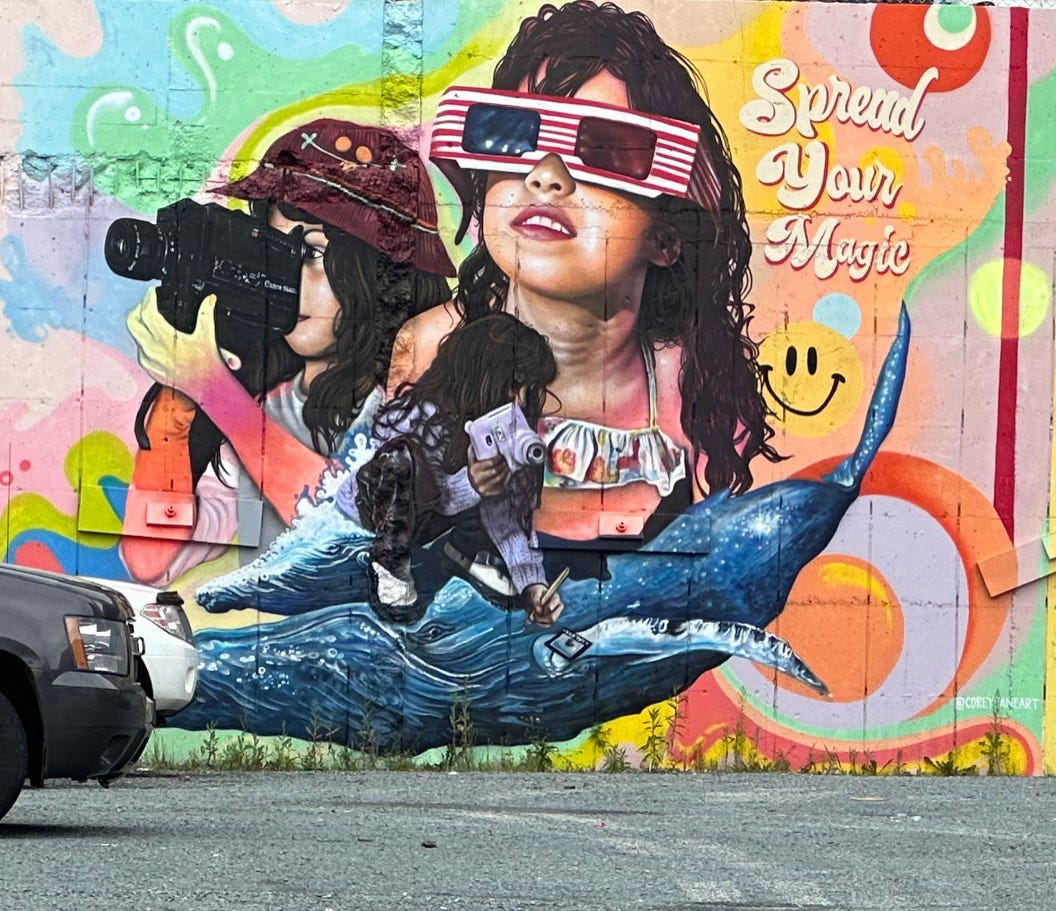
Photo: Jamie Feldman / Artist: Corey Pane

In the last long read I talked about Bill Lawrence and his mantra of “Everything goes my way!” His claim that, if he recites it enough, it becomes a self-fulfilling prophecy has got me thinking about the role of positive thinking in creativity. There are a lot of angles to approach this topic with — everything form magical thinking to psychology — so let’s dive in. I’d love to hear your feedback on the topic as well and I may open a discussion thread on the Substack app for free subscribers, so look out for that. Plus there’s always the comment section below to weigh in!
I supposed the easiest place to jump in is with magical thinking, the law of attraction, manifestation, and the good old power of positive thinking. I’m not going to say one way or the other whether I believe in this or not, but it is hard to ignore completely when so many prominent creatives credit some form of this to their success. Dave Grohl discusses fate, coincidences, and asking for things from the universe in his memoir, The Storyteller. Lady Gaga has openly talked about using mantras and repetition in the present tense. “You’re saying a lie over and over and over again but then one day, the lie is true,” she says. Jay-Z has talked about speaking things into existence, and Denzel Washington claims, “You attract what you feel, what you are.” The relationship between spirituality and creativity is also discussed in the much lauded The Artist’s Way by Julia Cameron, which is a sort of guide book for creative recovery.
Manifestation is a controversial topic, so I’ll strive to offer talking points for both sides of the argument. To start, let’s look to theoretical physics. It can’t be proven and plenty of it sounds pretty out there, yet many discoveries have come from it. Think of the Higgs Boson, the recent Nobel Prize for entangled photons/ violation of Bell inequalities, or even Stephen Hawking changing his beliefs on black holes. All this leaves possibly for there to be laws of attraction in the universe around frequencies or vibrations or whatever. I’m just saying, there could be. We also fully understand and accept that the placebo effect exists. People can literally believe themselves well from an illness even if the medications they are receiving are nothing more than sugar pills. What’s more is that we also know and accept that depression, mental abuse, and stress leads to serious physical illnesses. Stress alone lowers the immune system, and depression is a risk factor for dementia. So is this an argument for positive thinking? Maybe.
However, there may be a psychological explanation for the placebo effect — in part, anyway — that also speaks to both Bill Lawrence and Lady Gaga’s use of mantras. It’s all about belief and training your brain into subconsciously taking the actions necessary to achieve a goal. Likewise, creating a growth mindset can clear away self-imposed obstacles or negative beliefs about a goal. You’ll be more likely to attempt to achieve something if you already believe you can do it. Of course this doesn’t explain everything, and certainly leaves a lot to be attributed to luck and chance. It definitly does not negate the need for hard work, though it does make it more likely that you’ll be able to put in what it takes.
I do believe self-imposed obstacles are a major factor in determining who does and does not succeed creatively. As the saying goes, you miss one hundred percent of the shots you don’t take. I remember being in a creating writing workshop where it was well known that only about 3 or so people from each group published a novel once the course was over. At the time it seemed like an impossible task to figure out who would be the lucky few to publish. Everyone was incredibly talented and perhaps it wasn’t a stretch to think that our group would be the exception. It wasn’t. Hey, life is complicated and sometimes gets in the way or takes a funny turn that leads us somewhere else. Or sometimes we discover we love doing something different more! However, there have been many, many times throughout my life where I’ve witnessed crazy-talented people knock themselves out of the running due to some negative belief. Not being able to make money is a big excuse, or having major fears around harsh criticism and rejection is another. It is true that a lot of creatives bow out early not because they tried and failed, but because they perceived a potential failure and decided not to try in the first place.
On the flip side, I just want to say there is absolutely no shame in quitting or choosing a different path! I’ve quit lots of things! However, every time I consider quitting something I always ask myself if I truly want to quit, or do I just fear going forward because I think it could be difficult. It’s a pretty good litmus test for finding out how much you want something, and whether or not you’ll have regrets if you don’t at least try to pursue it.
So maybe this brings us to the myth of the depressed creative. You know the one. There’s usually a dude, probably a writer or painter, with an ashtray full of cigarette butts and a half empty quart of whisky beside him. He hasn’t slept in days (or taken a shower) and it’s all because his creative muse torments him so that he can create.
Yeah. It’s bullshit.
I don’t know about you but I’ve never been very creative during bouts of depression or extreme stress. Sure there’s something to be said for using hard times as fuel for creativity, or using a creative outlet to alleviate/work through stress, but that’s not the same as keeping yourself down in order to make art. Art is not solely born from despair! On the contrary, leaning too far into despair is a surefire way to be an inconsistent creator, which does not bode well for professionalism or success. The book The Artist’s Way, which has pretty much become the guidebook for creative recovery, uses many methods to move away from the blocked, depressed creative and toward a more positive state of creative flow. One of the most popular methods is called The Morning Pages, where a person free writes three pages of stream of consciousness thoughts before getting out of bed each day. It’s designed to clear the mental cobwebs, get out any anger and frustration, and uncover creative blocks. It essentially allows the mind to dump the junk, so to speak, in order to get a step closer to becoming focused and in flow.
I think all artists have an array of tricks to get themselves back into creative flow. Recently I saw an interview with Aaron Sorkin where we talks about getting through writing blocks by having multiple showers a day, acting out scenes by himself, and taking long drives with no planned destination. It’s like he needs to occupy part of his mind so that the rest of it can work out his plot problems. Similarly, Matthew Perry has been caught walking the streets of London, speaking his lines out loud in order to memorize them before going on stage in the West End. And likewise Zendaya has mentioned how she uses aromatherapy to get into different characters. The sense memory of the particular perfume or essential oil can trick her mind to jump back into character faster than anything else.
Perhaps this is what the myth of the depressed creative is really all about. The use of drugs and alcohol is the tool to get a creative back into flow. It distracts from the mental stress or depression or other problems inhibiting creativity. However, drugs and alcohol only act as temporary solutions and often make personal problems much worse. They do not lead to creative recovery, but merely act to give temporary creative glimpses. And well, there are enough famous artists out there who have met their demise from substance abuse.
Personally, I’ve used long walks to break through writing blocks. I’ve also used Zendayas’s sense memory trick, as well as written at the same cafe, or at the same time of day, or had the same type of tea while working in order to trick myself into a creative mood. I do think there is something to occupying or relaxing part of the mind that allows for creative breakthroughs. (It’s probably why I always blast loud music when I drive in rush hour. It cuts the anxiety by occupying my mind.) However, many of these types of tips and tricks could also fall under the label of creative ritual. There is a ton of science and psychology behind rituals and why they work, and there is also a ton of ritual work in magical thinking. I think it’s safe to say a lot of us light candles for various reasons. It’s both spiritual and a ritual.
Perhaps there really isn’t much difference between the logical writer who insists that real writers must carve out a set time to write every single day, and the spiritual writer who lights a candle to their muse each time they pick up their pen. Even though their approaches are very different, both are using a ritual as a way into creative flow.
So, maybe the gap between magic and science isn’t as far as we think it is…

This is truly thought provoking. Rituals,patterns and repetitions appear in many teachings and practices such as how to improve memory. Repeating a grocery list out load or the lines to a play enable use to memorize. Is it simply to remedy a pattern or ritual that brings a mythical muse to help the creative or is the mantra and manifestation a trick of the neurological system to activate a concentration in that area. Body builders repeat specific exercises to build body mass. Does the same principle work for creativity. Simply manifesting and practising the skills develops the outcome. Logically on one level absolutely. One the other level it appears like slight of hand magic. This was an amazing article